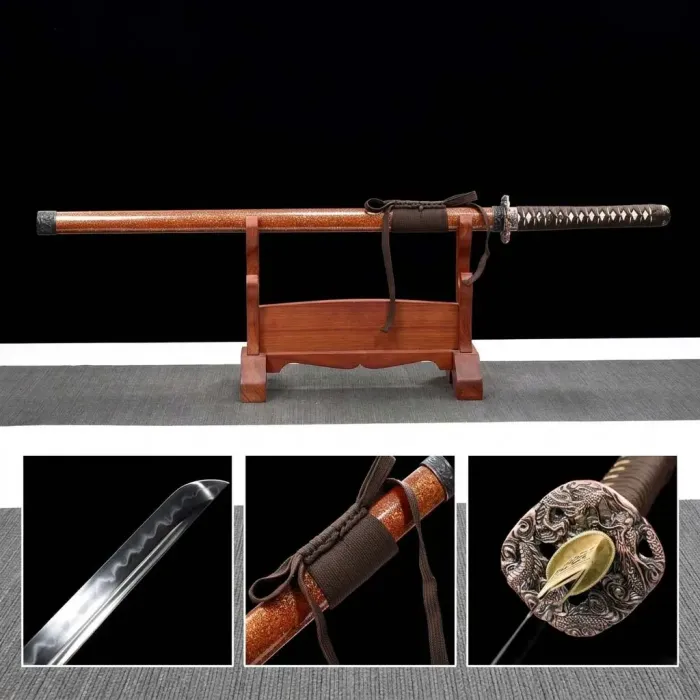
This conventional oriental sword serves as a impressive example of fabrication, but how about you long for to reveal your particular aesthetic? Altering your sword is a insightful journey, allowing you to create a truly uncommon piece. From the grip wrapping and binding to the guard design and heat mark, each aspect offers a chance for specialized modification. This investigation delves into the territory of katana adjustments, providing tips for both newcomers and accomplished enthusiasts seeking to set their trace on the ancient art of the samurai.
Novice's Verified Handiwork
For enthusiasts determined to embark on the exciting journey of historical swordplay, 1060 steel katanas offer an outstanding entry point. This chosen grade of fundamental steel hits a optimal point between economical cost and performance . While not quite as hard as upper-echelon steels, 1060 grants a moderate level of whetting, making it appropriate for learners to develop the rudiments of sharpening care and respect the beauty of traditional Japanese weaponry. It’s a wonderful choice for gaining experience without the investment burden of more specialized steels.
Type T10 Edges : Striking Capability and Economy
Enabling fans seeking an authentic weapon experience without surpassing the monetary limit , T10 material katanas represent a favorable option. These blades offer a reasonable improvement in toughness compared to cheaper alternatives, exhibiting decent edge retention and fair flexibility for rudimentary slashing techniques. While not rivaling the eminent characteristics of advanced steels like T100 or folded material , T10 provides a worthwhile blend of performance and value , making them a well-liked choice for trainees and those on a small earnings .
Past the Blade : Refining Your Armament's Adornments and Tsuka
Considering the finished steel is undeniably the focal point of a katana, truly heightening its appeal lies in the thoughtful customization of its features and haft . This art allows individuals to exhibit their distinct character. Contemplate the wide possibilities: menuki - decorative appliqués that offer visual focus; the hamon casings – often finely fashioned ; the tsuka foundation itself, wrapped in customary ito twine ; and the fusa pommel , which can be fabricated from various substances like treasures or antler .
- Adopt concepts that echo with you.
- Test with distinctive elements .
- Concentrate on excellence for a durable effect .
The Fascination of the Katana: Origins, Mastery, and Material
Every nihonto exhibits a special allure, steeped in generations of Far Eastern history and custom . More than merely a device of skirmishing, it's a representation of the knight ethos – a fusion of competence and self-control . Its growth spanned plentiful generations, with early blades evolving into the sleek curvature and sharp edge we understand today. The artistry involved is truly exceptional , requiring spans of coaching to master . The process involves a involved folding of smelted iron , creating layers that fortify the blade's flexibility and slicing ability. Multiple schools of crafting appeared , each with their special secrets and techniques for achieving the ultimate poise and acuteness - a truly grueling pursuit.
- Original Katana styles
- The task of the katana in samurai culture
- Ancient metalworking techniques
Choosing the Perfect Steel for Your Sword Project Project: 1060 vs. T10
Picking the proper steel is decisively important for any weapon project, and the judgment between 1060 and T10 can be tough. 1060 is a regular American compound, offering a fair balance of resilience and hardiness, rendering it somewhat easy to work. However, T10, a from Japan steel, usually boasts superior wear resistance and can perhaps achieve a elevated end hardness, although it can be significantly hard to manage and requires careful heat processing. Consider your experience level and aimed attributes: for a novice, 1060 may be a better entry, while wakizashi the experienced smith might use the improved characteristics of T10.
- Convenience of Handling
- Longevity
- Terminal Rigidity
Accessing Excellence: Progressive Katana Alteration Approaches
Developing mastery in sword adjustment extends far beyond basic sharpening. Serious dedicated users are now probing advanced techniques to truly reveal a blade's hidden potential. This demands intricate work with the temper design, utilizing specialized substances for differential processing and carefully picking the geometry of the shield to optimize balance and effectiveness. Beyond purely functional enhancements, artisans are increasingly focused on reaching unparalleled aesthetic beauty, through complex cutting and layered surfaces that truly transform a katana into a artistic composition.
From Raw Steel to Masterpiece: Crafting a 1060 Katana
The journey opens with ordinary 1060 material , a rigid material far separated the refined katana it will turn into . Skilled bladesmiths practice a complex process of integrating and constructing the rough steel, repeatedly warming it and flattening it to clear impurities and produce a homogeneous grain structure. This tedious process, often persisting for days , builds the required force and give characteristic of a legitimate Japanese sword . Continued heat refinements, including accurate hardening and conditioning , are indispensable to achieve the specific symmetry of sharpness, stability and elegance .- Combining: Diminishes impurities and creates grain structure.
- Crafting: Builds the steel into the initial blade form.
- Cooling: Sets the final hardness and flexibility.
The Lasting Drawing of the Katana: An In-Depth Look at Metal and Personalization
This time-honored katana survives a striking symbol representing Japanese civilization , its magnetism far beating mere weaponry . Forged from unique steel and commonly featuring intricate decorations , the approach of creation itself is a honored art. Beyond the central craftsmanship, the ability to refine a katana - from the hamon to the hilt wrapping and collar - grants for a deeply individual representation for both fans and handlers alike. This mixture of legacy steelwork and boundless personalization effectuates the katana's continued prestige across the terra .
